

Alpine cuisine is entering a decisive new phase. For much of the twentieth century, mountain food across Europe was defined by necessity: dumplings dense enough to sustain a day’s labor, cheese melted for warmth and calories, stews built for preservation rather than finesse. These dishes remain culturally vital, but by 2026 they no longer define the culinary identity of the Alps on their own. What is emerging instead is a cuisine shaped by environmental awareness, nutritional science, and a renewed respect for the landscapes that have always governed mountain life.
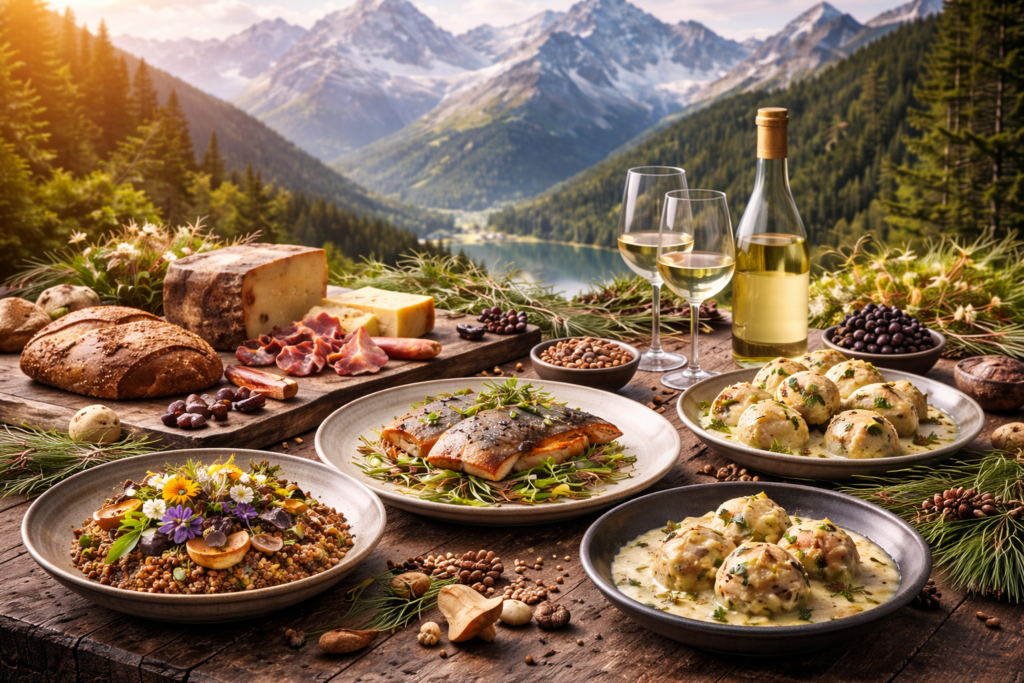
Across Austria, Switzerland, Germany, France, Italy, and Slovenia, chefs, farmers, and producers are converging around a shared ambition. They are not abandoning tradition, nor are they pursuing novelty for its own sake. Rather, they are reinterpreting Alpine food through a contemporary lens, one that values lightness over heaviness, precision over abundance, and ecological balance over excess. Wild herbs now appear alongside scientific approaches to performance nutrition, while ancient grains once dismissed as peasant food are re-emerging as cornerstones of modern Alpine cooking. By 2026, three powerful forces are shaping this transformation.
The Big Push Toward Change
The first major catalyst comes from outside the Alps themselves. In Sweden, the initiative known as _Food for White Winters_ launches at the FIS Alpine World Cup in March 2026. Its premise is deceptively simple: demonstrate that locally sourced, sustainable ingredients can meet the demands of elite athletic performance. The symbolic impact of this initiative should not be underestimated. When high-performance winter athletes are fueled by regional grains, fermented foods, and carefully balanced Alpine diets, mountain cuisine is no longer framed as indulgence but as functional, modern nutrition. What works for professional skiers quickly becomes aspirational for a much wider audience.
At the same time, the Winter Olympics in Milan–Cortina place Italian Alpine food under an unprecedented global spotlight. Media attention is drawn not only to spectacular landscapes but also to the food cultures that sustain life at altitude. Buckwheat, long a staple of marginal mountain agriculture, gains renewed visibility as a nutrient-dense, climate-resilient grain. High-altitude cheeses, produced under extreme conditions, are increasingly framed as expressions of terroir rather than rustic byproducts. The Olympic stage transforms regional food into cultural capital.
Underlying both developments is a deeper cultural shift that runs through all Alpine regions. There is a growing desire to reconnect with place in a literal sense. Chefs are building menus around what grows naturally in altitude-shaped environments, from roots and berries to hardy grains and cold-water fish. This movement, often described as a “New Alpine Identity,” emphasizes restraint and clarity. Dishes are no longer about abundance but about accuracy. Every ingredient must justify its presence, and every flavor should reflect the ecosystem from which it originates. Even the designated flavor of the year for 2026, Forest Pine, captures this sensibility, translating the scent of Alpine woods after rain into culinary expression.
Austria: Where Alpine Meets Asia
Austria illustrates this evolution with particular clarity. Entering 2026, the country presents one of the most dynamic food scenes in the Alpine world. A younger generation of chefs is blending deeply rooted Tyrolean traditions with techniques and philosophies drawn from Japan and other global culinary centers. The result is not fusion in the superficial sense, but a refined dialogue between cultures that share an emphasis on seasonality, precision, and respect for raw ingredients.
In Salzburg, Vitus Winkler continues to develop his “Herb Kingdom,” a culinary philosophy grounded in wild plants gathered from the surrounding mountains. His work reflects a broader Austrian trend: the transformation of foraging from rustic necessity into a disciplined culinary craft. Elsewhere, chefs such as Saul Sultan apply international technical rigor to local game, trout, and vegetables, achieving dishes that remain unmistakably Austrian in flavor while feeling contemporary in execution. Even mountain huts, once defined by simplicity and caloric density, are evolving into destinations recognized for culinary quality. Parallel to this development, Austria’s wine culture continues to mature, with Styrian Sauvignon Blancs and lighter expressions of Zweigelt aligning naturally with the new Alpine table.
Switzerland: Pure, Local, and Uncompromising
Switzerland takes a different but equally influential path. Rather than blending external influences, Swiss Alpine cuisine in 2026 is defined by radical locality. Several leading chefs commit to cooking exclusively with Swiss ingredients, a decision that challenges conventional fine dining but resonates strongly with diners seeking authenticity and transparency. Figures such as Sven Wassmer, Andreas Caminada and Stéphane Décotterd demonstrate that limitation can be a source of creativity, not constraint. Their menus highlight heritage grains, forgotten legumes, and traditional cheeses, many of which survive thanks to conservation efforts by organizations like ProSpecieRara.
This commitment to place extends beyond restaurants into tourism and education. Institutions such as the Culinarium Alpinum offer immersive experiences where visitors cook, ferment, forage, and travel to mountain farms, often by foot or snowshoe. In Switzerland, Alpine food culture in 2026 is not consumed passively; it is learned, practiced, and lived.
Germany: Reinventing the Mountain Hut
Germany’s Alpine regions, particularly Bavaria, are undergoing a quieter but no less significant transformation. Sustainability guidelines introduced by the German Alpine Club are reshaping how mountain huts operate, forcing a reconsideration of sourcing, waste, and menu composition. Traditional dishes remain present, but they are increasingly lighter and more plant-forward. Chefs in Munich and surrounding regions are rediscovering neglected cuts such as Kronfleisch and reviving nose-to-tail cooking as both an ethical and culinary practice.
At the same time, staples like Knödel are being reimagined to reflect contemporary values, incorporating vegetables, herbs, and fermented elements that reduce reliance on heavy fats. The return of the Murnau-Werdenfels cattle breed further illustrates this shift. Adapted naturally to Alpine pastures, the breed offers deep flavor while aligning with sustainable grazing practices. In Germany, Alpine cuisine in 2026 becomes a model of how tradition can evolve responsibly.
France: Haute Alpine Dining Takes the Lead
France approaches Alpine cooking with its characteristic sense of structure and refinement. In regions such as Savoie and Haute-Savoie, Michelin-starred heritage meets a renewed devotion to local lakes and high-altitude agriculture. Freshwater fish, particularly Lake Geneva pike, gains prominence as chefs explore lighter, more precise expressions of Alpine flavor. Often paired with foraged flowers or served in delicate broths, these dishes reflect a move away from excess toward elegance.
Traditional ingredients are not discarded but elevated. Crozets, the small buckwheat pasta squares once associated with humble mountain meals, are transformed into refined dishes finished with Beaufort cheese or seasonal truffle. As luxury ski resorts rethink their culinary identities, French Alpine dining in 2026 feels simultaneously rooted in terroir and open to innovation.
Italy: Fuel for the Olympics, Rooted in Tradition
Italy’s Alpine regions find themselves at the center of global attention. The Dolomites, Aosta Valley, and Valtellina serve not only as scenic backdrops for the Winter Olympics but as stages for a renewed appreciation of mountain food traditions. Buckwheat emerges as a defining ingredient, particularly in dishes such as Valtellina’s pizzoccheri, now reframed as ideal fuel for athletes and wellness-oriented diners alike.
In Aosta, preserved foods regain prominence. Fontina produced from summer-pasture milk and air-dried meats like motzetta are presented not as relics of the past but as sophisticated expressions of Alpine knowledge. Italian Alpine cuisine in 2026 balances sports science with deep cultural memory, offering dishes that nourish both body and identity.
Slovenia: The Forager’s Frontier
Slovenia, though smaller in scale, offers one of the most compelling Alpine narratives. In the Julian Alps, the influence of Ana Roš has brought international attention to a cuisine defined by foraging and immediacy. Here, the forest dictates the menu. Spruce tips, wild herbs, roots, flowers, and trout roe appear not as embellishments but as central elements.
Traditional dishes such as štruklji are reinterpreted as focal points rather than accompaniments, filled with ingredients that reflect season and place. Slovenian Alpine cuisine in 2026 feels alive and spontaneous, deeply connected to nature yet technically assured.
A Turning Point for Mountain Food
Despite regional differences, a shared logic unites the Alpine world in 2026. Food increasingly serves performance, supporting active lifestyles shaped by altitude and climate. The pantry is defined by resilience, favoring grains and crops that thrive under harsh conditions. Preservation techniques once essential for survival are rediscovered as sources of complexity and flavor. Travel itself is reshaped, with visitors seeking hands-on experiences that connect them directly to landscapes, producers, and culinary practices.
Taken together, these developments mark a turning point. Alpine cuisine is not simply modernizing; it is redefining its purpose. What appears on the plate is the result of centuries of adaptation combined with contemporary knowledge. Chefs rediscover ingredients shaped by cold nights and steep slopes, farmers reclaim pride in heritage crops, and diners look beyond comfort toward connection.
In 2026, Alpine cuisine steps into the future without losing its soul. That balance, between innovation and memory, may be its greatest achievement.
Sources Used Within This Articles
[1]: Food for White Winters: Fueling Athletic Performance and Sustainability – EAT
[2]: FIS – Sustainable Nutrition Boosted at Åre World Cup with “Food for White Winters,” Supported by FIS
[3]: A Culinary Guide to the Italian Towns Hosting the 2026 Winter Olympics
[4]: Gourmet Hotels in the Austrian Alps: Tyrol’s Finest
[5]: Vitus Winkler is Chef of the Year
[6]: Outlook 2026: Flavor Trends – IFT.org
[7]: Leftovers: Torani unveils 2026 flavor of the year
[8]: Why Austria’s ZillergrundRock Luxury Mountain Resort Should Be on Your Radar in 2026
[9]: The Wine Trend Report 2026
[10]: Uncorking 2026: 5 Wine Trends Redefining the Modern Wine List
[11]: Symrise x ProSpecieRara Collaborate for Sustainable Use of Plant Genetic Resources
[12]: Cuisine Helvetica x Culinarium Alpinum: Weekend Retreat 2026
[13]: Trofeo Rising Chef de San Pellegrino Acqua Panna
[14]: Le chef
[15]: Was ist eine ProSpecieRara-Sorte?
[16]: Culinarium Alpinum – Centre of excellence for cuisine in the Alpine region
[17]: Project Improving Alpine Hut Sustainability Successful
[18]: Alpine sustainability at mountain huts: project successfully completed
[19]: Traditional Bavarian food restaurants in Munich
[20]: Offal tasting in Munich
[21]: Where To Go in the French Alps
[22]: French Alps Cooking Vacations
[23]: A food and wine journey in the Aosta Valley: from wine to Fontina d’alpeggio
[24]: Pizzoccheri alla Valtellinese Italian Buckwheat Pasta
[25]: Pizzoccheri alla valtellinese (Buckwheat Pasta from the Italian Alps) – Memorie di Angelina
[26]: Discover Aosta Valley’s Unique Food and Wine
[27]: How Slovenian chef Ana Roš boosted the self-confidence of Czech gastronomy
[28]: Ana Ros on compromise, and why she will never cook chicken rice again
[29]: Cultural Landscapes of Slovenia Tour 2026
[30]: Best Of Slovenia Food & Drinks 2026
[31]: Rediscovered Wheat Treasure May Revolutionize Agriculture
[32]: On the Farm: Rediscovering Heritage Grains
[33]: Top 8 Health Food Trends for 2026: The Future of Nutrition
[34]: Unveiling 2026’s European Travel Trends: From Historic Hotels to Rural Retreats
[35]: Travel Trends 2026 #2: Shelf Discovery (according to Skyscanner) – Andrea Rossi
[36]: How Alpine Valleys Preserved Centuries of Culinary Traditions